Steelhead fishing has become a bit of an obsession for me lately.
Since about 2020, a few friends and I have made annual pilgrimages to the Salmon River around Thanksgiving to fish for these elusive fish. At first, I was thankful that we only went once a year. The sedentary, repetitive action nymphing a small handful of pools quickly became tiring, as did the crowds, who you often had to fight for the prime runs. The fact that you only hooked maybe three to five fish per day and landed one or two at best made the appeal even lower to a trout angler like me who’s used to double-digit days fairly often.
However, hooking them was a blast, and landing them was rewarding, which made me slowly develop a love-hate relationship with them.
What really opened my eyes was fishing the smaller tribs of Steelhead Alley as well as other Ontario tribs. The oftentimes less crowded and overlooked spots really opened my eyes to steelheading since I was no longer worried about fighting over a small handful of spots before sunrise with a multitude of fishermen. I also no longer had to worry about trying to find enough spots for all my friends to line up since there was generally more area to spread out in.
Fast-forward a few years, and I actually enjoy steelhead fishing now. And with any style of fishing that I love, I knew I had to broaden my horizons, so I decided to try Euronymphing for steelhead.
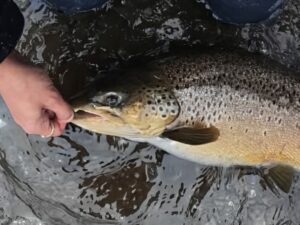
I know some of the regular readers might be confused reading this, but it’s true. Euronymphing for steelhead is a different beast than Euronymphing for trout. The flies used, the holding patterns, and the bite windows are much different than trout. In this post, I’ll go over a few of the lessons I’ve learned while steelhead fishing and share my most recent video where I fish for lake run brown trout and steelhead on Oak Orchard Creek during an exceptionally cold winter day.
Fishing Unweighted Flies
One of the biggest challenges that I encountered was fishing unweighted flies on a “Euro” system. Although you can fish weighted eggs for steelhead, I’ve found that unweighted eggs and beads can work much better under certain circumstances, such as lower and clearer water. In these instances, you have to fish your unweighted eggs or beads with anchor flies or split shot where regulations allow only one fly.
This technically approaches the realm of traditional “tightlining” rather than Euro nymphing, but since I mainly fish a mono rig while using this technique, I try not to sweat the semantics. Despite my initial misgivings that the split shot would ruin sensitivity, I was pleasantly surprised how little impact it actually had.
I’ve caught and hooked many fish while tightlining and had little difficulty picking up strikes, which are often fairly aggressive when fresh fish enter the system. Even when they aren’t aggressively feeding, it’s tough to miss a bite from fish this large without noticing.
Foul Hooking Fish
When you fish for steelhead or salmon in the Great Lakes tributaries, you are going to foul hook fish. This is a fact. There are so many fish piled in an area that it is often impossible to not foul-hook fish. Even if one fish bites, you may set the hook too late and hook his buddy on the side instead.
This problem is somewhat exaggerated by tightlining where the tendency is to set on anything “unnatural,” whether it’s the bottom or a fish. Sometimes, you may hook fish on the side when your fly grazes them, especially when water conditions are lower and fish are packed into certain areas. I hooked a fair number on the side the first couple times I went out and Euronymphed; however, I was able to distinguish from a bite versus a graze pretty quickly.
For the most part, when your fly is ticking along the bottom or along the side of the fish, it may feel like it is scraping or ticking along something. When a fish bites, you either know straight away if it’s an aggressive eat or it feels like your fly is weightless all of a sudden.
Steelhead Eat Nymphs
One of the biggest misconceptions I had when I started fishing for steelhead is that all they eat are eggs and junk flies, period. It made sense with their biology: they come in to feed on salmon and brown trout eggs and they themselves spawn before leaving. The only flies that I seemed to consistently have success on on the salmon river were egg flies and the occasional squirmy.
It wasn’t until I did a deep-dive into countless articles and YouTube videos that I started thinking otherwise. Steelhead are just as opportunistic as trout given the right circumstances and the memory of caddis and mayfly nymphs that they ate as smolt is as strong as the imprinting that brought them back.
They also eat Zonkers too, but that’s a whole other story. I’ve had really good luck fishing Blowtorches, Caddis patterns, Walt’s Worms, Stoneflies, and sometimes Perdigons on days when steelhead have seen everything under the sun. I’ve even had luck with a few experimental patterns that didn’t quite work that well on trout. Where multiple flies are allowed, nymphs work very well paired with “junkier” patterns such as eggs and worms.
Give it a try.
Discover more from BlogFlyFish.com
Subscribe to get the latest posts sent to your email.
Nice video. Brings back memories of 30 years ago fishing Oak Orchard for Steelhead. Of course using running line, 4# mono and slinkies to anchor the flies.
Just curious if you had to have your weight above the fly or could drop-shot?